Virtual annual DOT inspections are being marketed as a faster and more convenient alternative to having a qualified inspector physically examine a commercial vehicle. A driver, employee or other person walks around the vehicle with a phone while an inspector watches remotely, asks for certain views and then issues an annual inspection report or decal.
That may sound efficient. We do not believe it is an acceptable substitute for a proper hands-on annual inspection.
Truck Inspectors does not offer virtual annual DOT inspections. Our annual inspections are performed in person by a qualified inspector who physically examines the vehicle. We do not recommend remote-only annual inspections in which the qualified inspector relies on another person and a phone camera to perform the physical inspection procedures.
An Annual DOT Inspection Is More Than a Video Walkaround
The federal annual inspection requirement is found in 49 CFR §396.17. It requires every commercial motor vehicle subject to the rule to be inspected at least once during the preceding 12 months, and the inspection must include, at a minimum, the parts and accessories listed in Appendix A to Part 396.
The regulation goes further: a motor carrier may not use the vehicle unless each applicable component identified in Appendix A has passed the required inspection during the preceding 12 months.
That means the standard is not simply whether somebody looked at the truck, took photographs or completed a checklist. The applicable components actually have to be inspected against the federal minimum standards.
The regulations also address who performs that inspection. Under 49 CFR §396.19, individuals performing annual inspections must understand the inspection criteria, be able to identify defective components, and be knowledgeable of and have mastered the methods, procedures, tools and equipment used when performing an inspection.
Then 49 CFR §396.21 goes one step further. It states that the qualified inspector performing the inspection prepares the inspection report, identifies the components inspected, describes the results and certifies the accuracy and completeness of the inspection.
Those words matter.
If the person physically crawling under the truck, measuring components, operating controls and checking defects is an employee while the qualified inspector watches through a phone from somewhere else, a reasonable question follows:
Who actually performed the inspection?
The Federal Standards Require More Than Looking at a Vehicle
Many people picture an annual DOT inspection as a walk around the vehicle checking lights, tires and paperwork. That is only a small part of it.
A proper commercial vehicle inspection involves getting underneath vehicles, looking behind and between components, applying systems, checking movement and looseness, listening for leaks and taking actual measurements. Depending on the vehicle, the inspector may spend a significant amount of the inspection crawling, reaching, kneeling and repositioning just to examine the components covered by Appendix A.
Air brakes are a good example.
Appendix A specifically identifies defects involving brake chambers, mechanical brake components, hoses, tubing, drums, rotors, linings and pads. It expressly includes an audible air leak at a brake chamber as a defect.
Brake adjustment is not determined by looking at a phone screen. Appendix A establishes maximum brake pushrod stroke limits and specifies that stroke is measured with the engine off, reservoir pressure between 80 and 90 psi and the brakes fully applied. Brake linings and pads have minimum thickness requirements. Linings saturated with oil, grease or brake fluid are also addressed by the inspection standard.
Brake hoses have to be checked for physical damage, bulging or swelling under pressure and audible leaks. Brake tubing is also rejected for an audible leak.
A leaking air-brake chamber can make a sound an inspector standing beside or underneath the vehicle immediately recognizes. A remote inspector hears whatever the phone microphone, wind, engine noise, surrounding equipment, connection quality and the person holding the phone allow them to hear.
Those are not equivalent inspection environments.
Tires are much more than tread depth.
We regularly see people reduce a tire inspection to putting a tread-depth gauge into the tread. The federal standard requires considerably more.
- Exposed body ply or belt material
- Tread or sidewall separation
- Cuts exposing ply or belt material
- Certain improper repairs or tire applications
- Contact between a tire and another vehicle component
- Load and inflation-related conditions
- A flat tire or a noticeable leak that can be heard or felt
- Minimum tread-depth requirements
Some tire damage is obvious in a photograph. Some is not. Damage can be on the inside sidewall, between dual tires, near a suspension component or visible only from a particular angle. An in-person inspector can reposition, touch, listen and continue investigating when something does not look or feel right.
Steering, suspension and frame components require close examination.
Appendix A addresses steering free play, loose or missing steering components, cracks, movement in ball-and-socket joints, tie rods and drag links, spring and suspension defects, axle-positioning components, frame cracks and missing or loose fasteners.
Many of these components are underneath the vehicle, behind wheels or partially obstructed. Checking them properly can require the inspector to change position several times, use a light, observe components while the steering is loaded or moved, and get close enough to distinguish acceptable movement from a defect.
Wheels, rims, coupling devices, fuel and exhaust systems matter too.
The inspection also reaches wheel and rim cracks, elongated bolt holes, loose or ineffective fasteners, weld defects, fifth-wheel and coupling components, fuel-system defects, exhaust-system defects and many other safety-related items.
A phone camera can be useful for documenting a defect after it has been found. We do not consider it a substitute for having a qualified inspector physically present to find the defect in the first place.
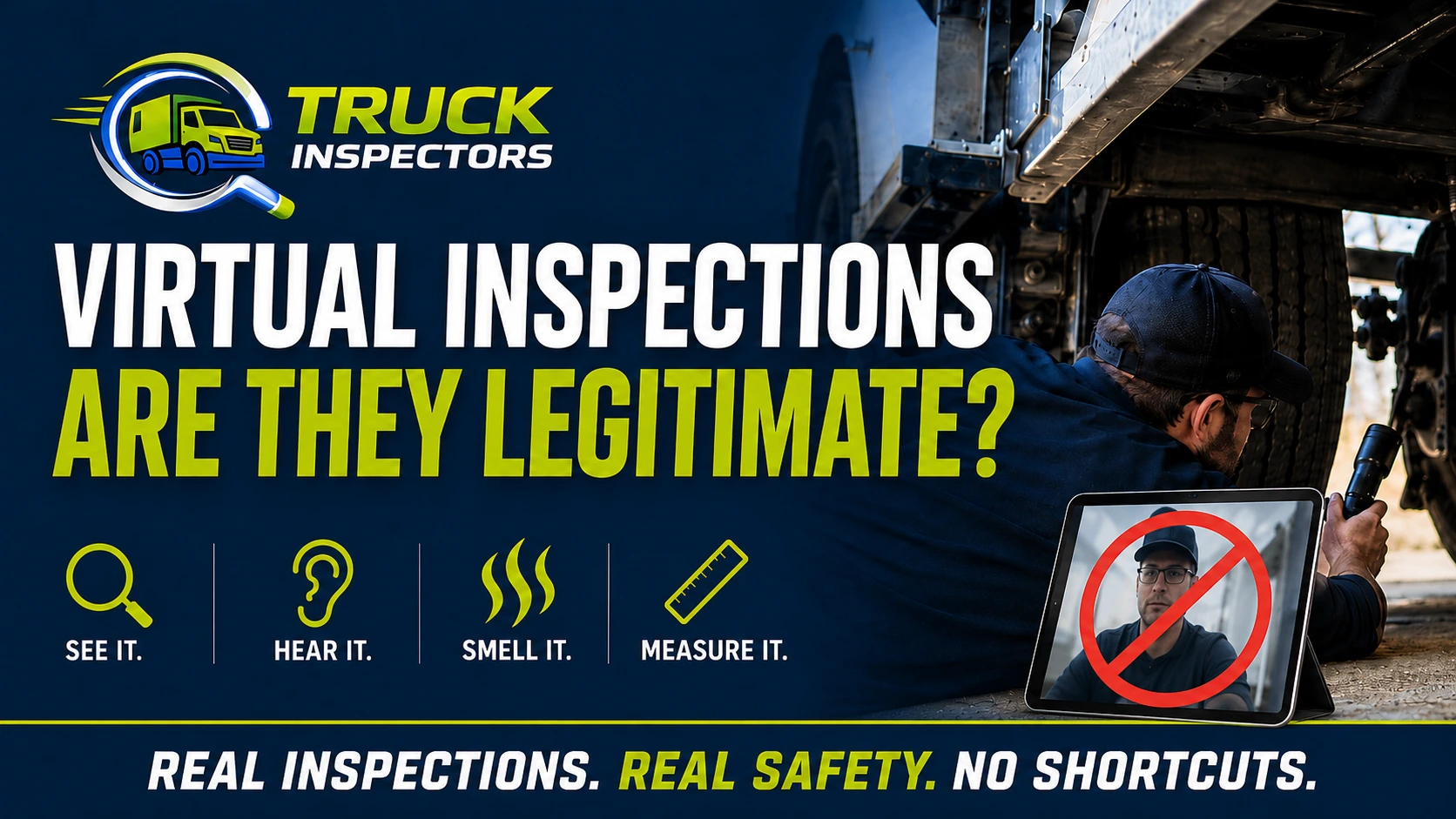
See It. Hear It. Smell It. Measure It.
The federal inspection standards themselves require more than simple visual observation in several places. Appendix A refers to leaks that can be heard or felt, components checked under pressure and measurements performed under specified conditions.
An experienced inspector also uses sensory clues to determine when something deserves a closer look. The odor of fuel, gear oil, overheated lubricant or overheated brake material can draw attention to a developing problem. Smell by itself is not automatically a federal pass-or-fail criterion, but it can be an important clue that causes an inspector to investigate further.
The same is true of a faint air leak, unusual movement, contamination or looseness that becomes obvious only when you are physically next to the component.
A remote video connection filters those clues through a camera, microphone, network connection and the abilities of the person holding the device.
Electronic Records Are Allowed. That Does Not Create a Virtual Inspection Standard.
FMCSA allows many required records and signatures to be created and maintained electronically. Electronic paperwork is not the issue.
An electronic inspection report and a remotely conducted physical inspection are two very different things.
We have found no separate federal “virtual annual inspection” standard in Part 396 that reduces the inspection criteria because video, photographs or electronic forms are being used. Every applicable Appendix A component still has to pass, the individuals performing annual inspections still have to meet §396.19, and the qualified inspector performing the inspection still certifies its accuracy and completeness under §396.21.
The Biggest Question: Who Is Actually Performing the Inspection?
This is the issue we believe motor carriers should take most seriously.
If a qualified inspector is hundreds of miles away giving instructions while a driver or office employee performs the physical work, who measured the brake stroke? Who checked the inside sidewalls? Who evaluated steering movement? Who crawled underneath the vehicle to examine the suspension, frame and brake components? Who listened at the brake chambers, hoses and tubing?
And most importantly:
Does the person actually performing those inspection procedures meet the qualifications required by §396.19?
A video call may allow a qualified person to advise another person, ask for additional views or document what another person is doing. But that does not change the language of Part 396 or reduce the inspection criteria in Appendix A.
FMCSA does not appear to have published a blanket statement declaring every possible use of remote technology during an annual inspection unlawful. At the same time, we have found no remote-inspection exception that allows required inspection procedures to be skipped, performed inadequately or delegated to an unqualified individual simply because a qualified inspector is watching by video.
The Motor Carrier Still Owns the Risk
This is where convenience can become expensive.
Under §396.17, it remains the responsibility of the motor carrier or intermodal equipment provider to ensure that the applicable parts and accessories are maintained at, or promptly repaired to, the minimum standards in Appendix A. The same section states that failure to properly perform the required annual inspection subjects the motor carrier or intermodal equipment provider to the federal penalty provisions referenced in the regulation.
The inspection report is not disposable paperwork. Under §396.21, it identifies the inspector, vehicle, components inspected and inspection results, and the qualified inspector certifies its accuracy and completeness. The report must be retained for 14 months and made available on demand to an authorized Federal, State or local official.
Now consider that record after a serious crash involving a brake, tire, steering, wheel or suspension failure.
If the vehicle’s mechanical condition becomes part of a crash investigation or later litigation, the inspection record may receive much more scrutiny than it did when the decal was issued. Questions may be asked about who actually performed the inspection, what procedures were performed, what was measured and how the inspector determined that the component met the federal standard.
A certificate saying that a vehicle passed does not change the physical condition the vehicle was actually in.
If a required inspection procedure was never actually performed, or if a defect was missed because the person conducting the physical examination did not know what to look for, a cheap and convenient annual inspection can become very difficult to explain later.
The decal is not the inspection. The inspection is the process used to determine whether every applicable component meets the federal standard. The report and decal document the result of that process.
Questions to Ask Before Buying a Virtual DOT Inspection
If you are considering a remote annual inspection service, ask the provider these questions before relying on its inspection:
- Who is the §396.19-qualified inspector? Ask for evidence of the inspector’s qualifications.
- Will that qualified inspector actually be at the vehicle?
- If not, who physically performs the inspection procedures?
- Does that person independently meet the applicable inspector qualifications?
- Who measures brake pushrod stroke, brake lining thickness and tire tread depth?
- How are inside tire sidewalls, dual tires and obscured components inspected?
- How are audible leaks at brake chambers, brake hoses and brake tubing checked?
- Who physically examines steering, suspension, frame, wheels and coupling components?
- Who certifies that the inspection was accurate, complete and compliant with every applicable Appendix A requirement?
- What federal regulatory basis does the provider rely on for its remote inspection process?
If the process ultimately amounts to an unqualified person pointing a phone wherever a remote inspector tells them to point it, we would think very carefully before relying on that process as your annual federal safety inspection.
Why Truck Inspectors Will Not Offer Virtual Annual Inspections
We understand the appeal. Virtual inspections can reduce travel, simplify scheduling and lower the cost of providing the service.
We still will not offer them.
When we sign an annual inspection report, we are certifying that the inspection was performed accurately and completely. We are not comfortable making that certification from the other side of a phone while somebody else acts as our eyes, ears and hands.
Commercial vehicles are heavy, complex machines operating next to the public every day. Brakes, tires, steering, suspension, wheels and coupling devices are not paperwork items. They are safety systems.
For that reason, Truck Inspectors performs annual DOT inspections in person, and we recommend that motor carriers use a qualified inspector who physically examines the vehicle.
Electronic reports are convenient. Electronic record storage is convenient. Online scheduling is convenient.
The inspection itself is one place we do not believe convenience should replace physical verification.
Federal Sources
- 49 CFR §396.17 — Periodic Inspection
- 49 CFR §396.19 — Inspector Qualifications
- 49 CFR §396.21 — Periodic Inspection Recordkeeping Requirements
- Appendix A to Part 396 — Minimum Periodic Inspection Standards
- FMCSA Motor Carrier Safety Planner — Vehicle Inspections
This article discusses the federal periodic inspection requirements in 49 CFR Part 396 and is provided for general informational purposes. Individual vehicles, operations and State requirements may be subject to additional rules.